

FASTER THAN EXPECTED
War and Climate Change

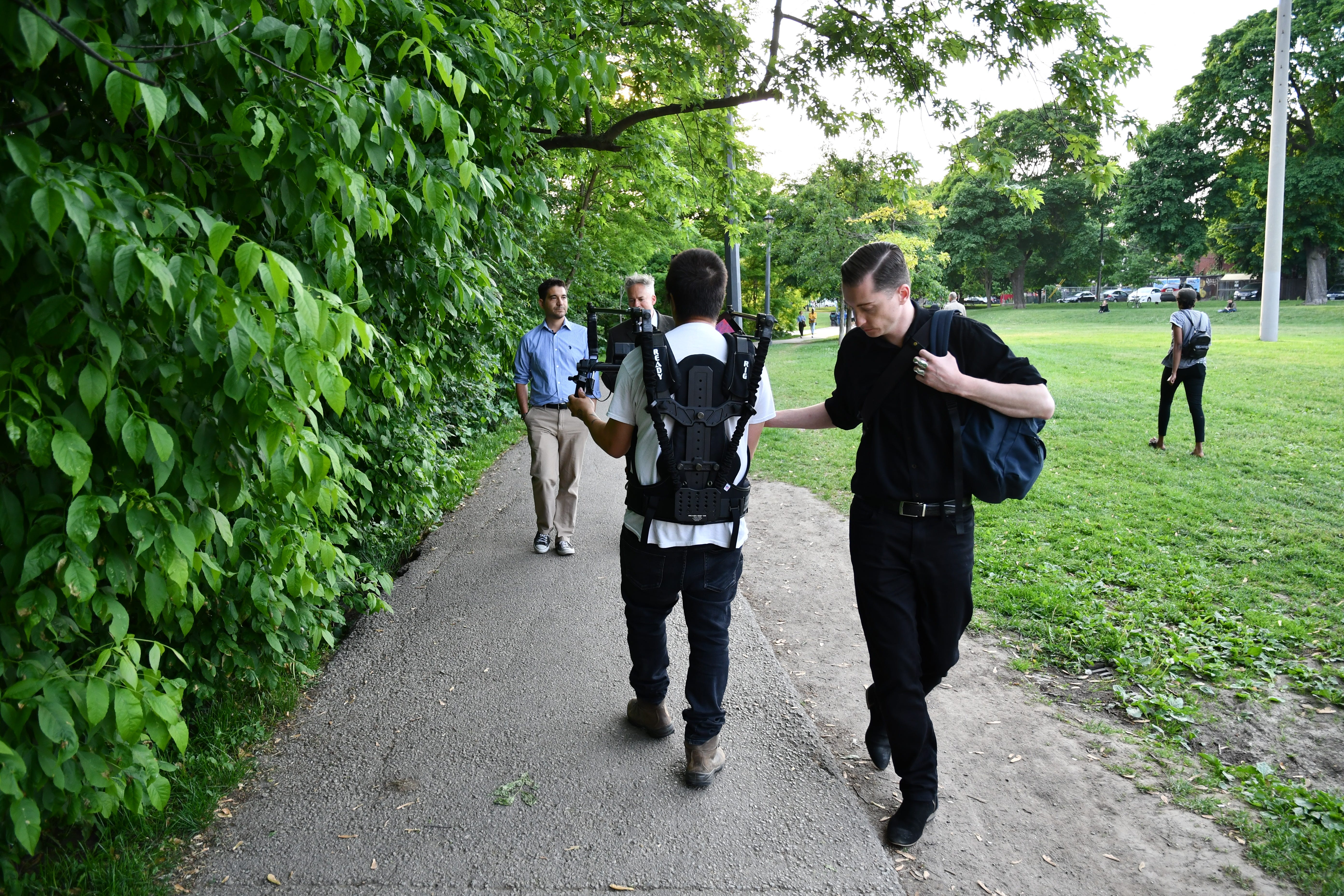
Filming “Who Farted?” in Toronto, 2018
“How can you hide from what never goes away?”
― Heraclitus
In late 2023 Greta Thunberg turned her attention to Gaza and something in the climate narrative changed. If she could be swayed by causes greater than a climate apocalypse, did she really mean all that shame-on-you stuff that made grown men cry? I don’t blame her at all. She’s so young, it was absurd to place such weight on her, and war is always worthy of protest. But her absence is felt.
Climate collapse is unthinkable, so let’s not think about it. Statistics show 44% of people are anxious about climate change, but the political class and the culture have moved on. Yuval Noah Harari points out that humans are hardwired to see other people as a threat, but not nature, which we have been busy taming for most of our 200,000 years wandering the planet. Those people on the other side of the hill are always the problem. Also, we’re good at making weapons.
We began to industrialize only a century-and-a-half ago, and in a flash, we are masters of the continents, seas and skies. This turns out to be a problem, because burning the decayed matter that fuels all this is exponentially heating the Earth’s atmosphere, and with it, us.
These truths are widely known. It’s possible we’ve already arrived at Kübler-Ross’s final stage of grief, acceptance (I know I have) but more likely we’ve collectively decided war is just more interesting than climate change. It is. Climate change movies are pedagogical or metaphorical. War movies are endlessly entertaining. Climate books are hectoring or alarming, war books are legion — with a fresh shelf about to arrive.
In 1989 I transcribed tapes for David Suzuki and Anita Gordon’s book It’s a Matter of Survival, based on the CBC radio series that kickstarted the nascent environmental movement in Canada. It was inspired by a 1988 climate conference in Toronto that famously took place during an unusually crippling heatwave. The attendees concluded that the warming climate was an existential threat arriving faster than expected.
The 1988 conference happened the same week as another iconic moment in environmentalism. NASA scientist James Hanson told the US Senate that global warming was human-caused and posed a significant danger. The science was and is forboding, even terrifying. It was clear we had twenty or thirty years to wean ourselves off oil and gas or we would face cascading environmental catastrophe.
Thirty-six years later, it’s a five-alarm fire. Of course, somebody is always claiming the sky is falling. There are so many Chicken Littles. Eschatology is a genre. Yet, the science is clear. The planet is rapidly heating up. A few years ago, there was a website called “faster than expected” which gathered every news story that used a variation of that phrase. The website is gone but the phrase shows up often. In March 2026, the New York Times ran another alarming climate story: “Many of the consequences of global warming — such as more intense storms, warming oceans and melting glaciers — are arriving faster and more powerfully than many scientists had expected.”
It’s a Matter of Survival, which leans into Paul Ehrlich’s misanthropic overpopulation thesis, earned Suzuki and the environmental movement the scornful motto: “Nature good. Man bad.”
Man is often a bad animal, but nuance is everything. Enmeshed in the AIDS epidemic during the 1980s, I saw a fierce value for life all around me. It’s impossible to convey the medieval horrors visited on healthy, vibrant young men, dying in a perceived moral retribution. It manifested first as distant, confusing news and then, as all plagues, was everywhere inflicting its torments. Most who survived are psychologically scarred, but few of us are nihilists.
After writing a series of articles on the emerging AIDS crisis for Toronto’s Now Magazine, Kevin Orr from the nascent Aids Committee of Toronto asked me if I knew how to use a grant earmarked for an educational film. The result, No Sad Songs, premiered at the 1985 version of the Toronto International Film Festival and went on become a historical artifact, recently completing a three-year run on the prestigious MUBI streamer.
No Sad Songs appeared before the plague truly began to ravage my friends and lovers. It felt like we were Cassandras warning of impending doom while everyone continued to party. That society functioned normally among all the death and despair was a unique feature of that plague, not dissimilar to the sense of alienation that applies to those involved in climate science and activism.
Transcribing those tapes for the book in 1988, I did pick up on the nihilism that has long dogged environmentalism and will always appeal to young thinkers coming to terms with much of the rottenness of the world. Climate collapse is a misanthrope’s fever dream: humans are akin to a cancer attacking nature, which will eventually repel us with fire, flood and starvation. The implicit critique of capitalism, which requires endless consumption and growth, has made it difficult for environmentalism to wrestle itself from hard left anarchism. Moreover, the progressive left has mostly abandoned environmentalism to engage in purity tests of “Semitic, philo or anti?” There is no doubt the Holocaust is the singular event of the modern era. Its legacies, including the mid-east ethnostate it birthed, haunt and preoccupy us. However, the future portends something so much more unimaginable which, too, is quantifiably undeniable.
The word now is adaptation. We just need a bigger boat.
The sheer scale of the issue is daunting, and it has proven notoriously difficult to communicate outside of cults and doom loops. There are a handful of anguished books, and very few films, most appearing in the late 2010s. There’s also a fair body of literature that sells well that will tell you there’s no problem at all.
As a filmmaker, I’m fascinated by the challenge of how we approach our anxieties through cinema, always being part of the immediate zeitgeist but striving to create something timeless. Knowing there was nothing to say more to say to the intelligentsia, I tried a populist approach. More on Who Farted? in a moment. In filmmaking, it’s notoriously difficult to make a successful “essay” film. A weakness of the format is it relies heavily on the charisma of its human subjects; a face must be attached to every story.
Al Gore’s 2006 slideshow-turned movie, An Inconvenient Truth, directed by Davis Guggenheim, remains the most well-known climate film. Yet the tying of the climate issue to him was as problematic as it is to Thunberg. Aside from the politics, Gore could never completely shake trumped-up charges of dilettantism. A follow up film chronicling his worthy initiatives was derailed in the smoke of 9/11, see Harari, above.
Leonardo DiCaprio narrated 2016’s Before the Flood and 2019’s Ice on Fire. There’s a familiar format to the genre. Stats, languid drone shots of melting ice floes, hopeful ideas toward a sustainable world. DiCaprio parodied his own role as a climate activist by playing a bewildered scientist in Adam MacKay’s clever 2020 satire Don’t Look Up!, where a comet is about to hit the Earth with the same inevitability of the emerging climate catastrophe. Not everyone understood the metaphor — satire is never populist.
There are available films that expose how we’re being misinformed. Robert Kenner’s 2014 documentary Merchants of Doubt traces how public relations tactics like those of the tobacco industry are in play. The three-part series BBC/PBS series Big Oil Vs. the World, 2022, directed by Jane McMullen, is a forensic examination of how Exxon and others actively spread crude obfuscations.
Arguably, the most profound, beautiful and sad work of the climate change documentaries is David Attenborough’s 2020 A Life on our Planet. In a sobering turn from his iconic awe of nature’s beauty, he offers the darkest of warnings, now a meme: “the collapse of civilisation is on the horizon.” His later works have shifted back to his traditional fare. He turns 100 May 8, if he wants to talk about Gorillas, we’ll watch.
First Reformed from 2017 is an art film by Paul Schrader which directly and awkwardly addresses the anxieties of the issue from the perspective of hope and faith. Another art film from 2017, Darren Aronofsky’s Mother, is an allegory from the perspective of Mother Earth. Both remain curios. In interviews, the artists have to be explicit they are talking about climate change.
Michael Moore streamed Jeff Gibbs’ 2019 Planet of the Humans on his YouTube Channel and millions watched. An often clumsy polemic that dares deny shibboleths, it excoriates green orthodoxies, pointing out even EVs consume vast resources. Environmentalists were offended by its pessimism and jumped on its flaws. Enemies gloated.
I’d kept in touch with Albert Nerenberg since Bruce Cowley at CBC’s documentary channel had connected us regarding a film that explored the cultural impacts of human flatulence. I delighted in the project’s transgressive, humanist quality.
Albert, another quirky and delightful talent in the Canadian firmament of oddball filmmakers, had come under the spell of Guy McPherson, the climate doomsaying professor whose Going Dark predicted near-term human extinction, suggesting that by the mid 2020s there would be nobody left alive on Earth. Scoffing at the timeline, I began my due diligence and was dismayed to learn McPherson wasn’t entirely a crank. Many of the cascading climate effects he talks about are real or potentially real. Just as was predicted back in the 1980s. The argument is ultimately about the timeline. New York Times’ columnist David Wallace Wells wrote a respected 2019 book The Unhabitable Earth that paints a famously dire picture. He devotes a sympathetic page to McPherson’s ideas. Bill Nye profiled him in a science show, tempering the implications of McPherson’s predictions with a gag about getting drunk.
McPherson was the first interview we filmed for Who Farted? which had morphed from a cultural comedy to an environmental cri de coeur. Albert insisted on filming McPherson in a church. The plan was for a populist film that would gently point out we are all part of nature, not separate from it. Burning fossil fuels is the problem. Putting the onus of the individual to recycle or not eat meat is a sideshow. And fart history is fascinating and universal.
It seemed a revelation to me, and I saw the irony immediately. Here we were, once again Cassandras before the flood.
Who Farted? premiered in 2020 in time for the covid pandemic. It lingers on CBC’s GEM and is available worldwide. In the film, McPherson tells us he doesn’t expect anyone left on Earth by 2027, even 2026. Recently, Albert posted a clip of this to his Facebook page, and we marveled how freaked out we were by the prediction at the time. But the words of the other climate scientists in our film remain true. Mojib Latif in Hamburg echoes the mainstream scientific view that global warming leads to disaster for the global south. I’ve been keeping track of the science since then and I understand why others championed McPherson. Climate collapse is moving faster than expected.
My sense is the real explanation of why climate has fallen off the public discourse is we’ve collectively decided AI is going to solve the crisis for us. A vast amount of electricity is required for this, many of the tech companies are going with gas generators, whatever it takes. Our appetite is insatiable. But just as science can warn us, it can presumably save us.
Everywhere we are newly militarizing our economies, as even climate advocates like Mark Carney know that’s where the money is. (I have to assume he’s playing the long game). And fate can be wondrous, as history has proven to us repeatedly. The folly of Trump’s oil war — they are all oil wars — might even give that definitive push to a sustainable future we so badly need. We don’t need spokespeople, movies, or books, just a few vain men, never in short supply.
Thought provoking , much to think about in this article ,well written